

Is it possible that something happening in your mind can contribute to actual physical pain? Isn’t that the sort of pseudoscientific theory you read about in a fringe magazine or hear from some self-styled “guru” on a podcast? Maybe.
Mental stress is something we all experience. We may worry about our work, our finances, our family responsibilities, or our schedules. No one doubts that stress can take a toll on our health. It’s not as obvious, though, how that stress can have an immediate impact on our bodies. You may notice that after a stressful day your jaw is clenched or your neck feels stiff. It may have completely escaped your attention that your shoulders have been practically touching your ears all day.
Yes, mental stress can contribute to muscle pain. Your body’s response to stress can cause your muscles to tense automatically. When the stress is frequent or chronic, those tensing muscles can hurt. If you have a stressful day while you’re already experiencing some kind of musculoskeletal pain, you may notice that pain getting worse.
What Happens to Your Muscles When You’re Stressed?
Your body has an automatic response to stress buried deep in its genes. This stress response has played an important role in keeping our species alive through many challenging times and circumstances. When the brain perceives a threat or challenge, the autonomic nervous system activates the body’s stress response. When this happens, things change internally1:
- Your heart rate increases.
- Your breathing becomes faster.
- Your blood pressure rises.
- Stress hormones are released.
- Your muscles tense in preparation for action.
All these changes can be helpful when you’re responding to an immediate threat like a stalking tiger or an invading tribe. In fact, these stress responses can be helpful in some modern scenarios as well. The problem is your nervous system can initiate the same stress response after a stressful day at work or an argument with your spouse. Often, these physical symptoms can pass quickly and you can relax, but when we are stressed frequently or for extended periods, the physical toll becomes noticeable.
How Muscle Tension Can Turn Into Muscle Pain
While it may be an oversimplification to just say “stress causes pain”, it is well understood that the body’s reaction to stress induces musculoskeletal conditions that can contribute to pain. A muscle that repeatedly tightens without fully relaxing can become sore, stiff, or fatigued. This is something you can notice after performing any repetitive task that requires using a muscle over and over again in the same way. Stress can produce a similar condition, even if you don’t notice it happening.
Aside from the direct impact stress has on your muscles, it can also affect the way you move. A person who is stressed may:
- Sit at a desk for longer periods.
- Move less throughout the day.
- Adopt a more rigid posture.
- Clench their jaw.
- Tighten their shoulders.
- Exercise less.
- Spend more time looking down at a phone.
When you combine these additional factors with the original muscle tension, It’s easy to understand how they can contribute to muscle pain.
Stress may also change how we experience pain
Another important factor to consider is that the pain we experience isn’t a simple measurement of tissue damage. The experience of pain is produced by the nervous system and brain working together, and it can be influenced by your emotional state, sleep, stress, and other factors.
Research has shown that repeated or chronic stress may increase your sensitivity to pain, or make an existing painful condition feel worse. That’s not to say that the pain is imaginary or “all in your head” – it’s simply because the nervous system plays an important role in how strongly we experience pain. This is a phenomenon sometimes referred to as stress-induced hyperalgesia2.
The Stress-Pain Cycle
The relationship between stress and pain can lead to frustrating feedback loop that ends up making both worse. Your stress can lead to muscle tension, which leads to pain, which leads to frustration and trouble sleeping, which leads to more stress, and so on.
This cycle can also start at a different point. Let’s say you have a painful injury. You then feel stress about the pain and the possibility of missed work or just less activity. The stress increases the sensitivity to the pain, making the pain more intense. This leads to more stress, and so on.
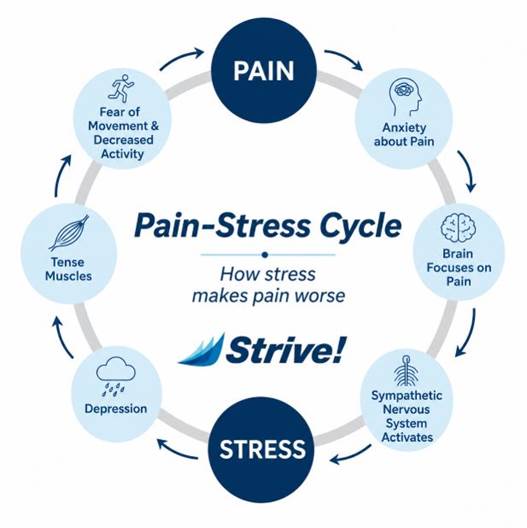
Breaking this cycle often requires addressing several factors simultaneously. Reduce the pain and reduce the stress. This is obviously easier said than done, but just being aware of this cycle can help you maintain the mindset you need to overcome it.
What Can You Do About Stress-Related Muscle Pain?
Understanding the relationship between stress and pain is a big part of the battle. The next step is to make this understanding actionable. Because stress-related muscle pain involves both physical tension and your body’s broader stress response, dealing with it should involve both of these factors. Stretching and healthy movements can play a role alongside addressing the psychological aspects of pain3.
Some suggestions to help you reduce both your pain and your stress can include:
- Keep moving:
Both pain and stress tend to make people less active. It’s important to avoid pushing yourself too far, but if you can, try shorts walks or gentle mobility exercises to keep your muscles active and your mind distracted. - Pay attention to unconscious tension:
Make sure you’re not hunching your shoulders or clenching your teeth. Try to keep your body loose and relaxed. - Try relaxation strategies:
Taking a short walk or just spending time outdoors can be very relaxing. Try meditation or some simple breathing exercises. As much as possible, keep your mind and body relaxed. - Don’t underestimate sleep:
Both stress and pain can interfere with sleep, and poor sleep can make both of them harder to manage. Not getting enough sleep is a great way to keep yourself locked in the stress-pain cycle.
Stress-related muscle pain can make our daily lives frustrating and our normal activities difficult. Doing what you can to keep both things from getting worse can have a major impact on your overall wellbeing.
Of course, it’s important to consider the underlying physical components of pain. Even if stress is a contributing factor, pain often results from muscle weaknesses or imbalances, poor posture or movement patterns, or repetitive use.
How Physical Therapy Can Help
While physical therapists don’t treat psychological stress itself, addressing the musculoskeletal consequences and helping people return to comfortable, pain-free lifestyles can have a very positive psychological effect. A physical therapist can evaluate:
- The underlying physical source of your pain
- Strength or mobility issues
- Posture or movement patterns that may be contributing factors
A professional evaluation can result is a personalized treatment plan that can help you overcome the pain while improving your strength, mobility, and flexibility. Helping your body move more efficiently and more comfortably will go a long way toward helping you feel better, both physically and psychologically.
If you or a loved one is dealing with stress-related pain, don’t hesitate to reach out to a qualified physical therapist. It can be an important step in getting back to living your best life.
Our caring and compassionate therapists at Strive! have been helping Ocala area residents overcome pain for more than 40 years and would be happy to provide you a professional evaluation. Call us at 352.690.7777 or email us today to schedule an evaluation.
Sources
- National Center for Complementary and Integrative Health. “Stress.” Nccih, Apr. 2022, https://www.nccih.nih.gov/health/stress.
- Jennings, Elaine M, et al. “Stress-Induced Hyperalgesia.” Progress in Neurobiology [England], vol. 121, 2014, pp. 1–18, https://doi.org/10.1016/j.pneurobio.2014.06.003.
- American Psychological Association. “Managing Chronic Pain: How Psychologists Can Help With Pain Management.” Apa.Org, 2013, https://www.apa.org/topics/pain/management.